



AI-Driven Cyber Threats Demand Global Action, Experts Warn at ICSC 2026
By Azeez Ajibola Afolabi
Cybersecurity experts, lawmakers and international partners have called for stronger global cooperation to combat emerging cyber threats powered by Artificial Intelligence, warning that the fast-evolving digital landscape is forcing nations to rethink how they protect citizens, institutions and economies.

The call was made on Tuesday at the opening ceremony of the International Cybersecurity Conference 2026 (ICSC) in Abuja.
Speaking at the event, the Director-General of the National Information Technology Development Agency (NITDA), Kashifu Inuwa Abdullahi, CCIE, said cybercriminals are now using AI to create a new dimension of threats, forcing organizations to deploy more advanced tools to anticipate, detect and neutralize attacks.
Inuwa distinguished between cybersecurity and cyber resilience, explaining that while cybersecurity aims to prevent attacks, cyber resilience is the capacity to recover and continue operations after an attack has occurred.
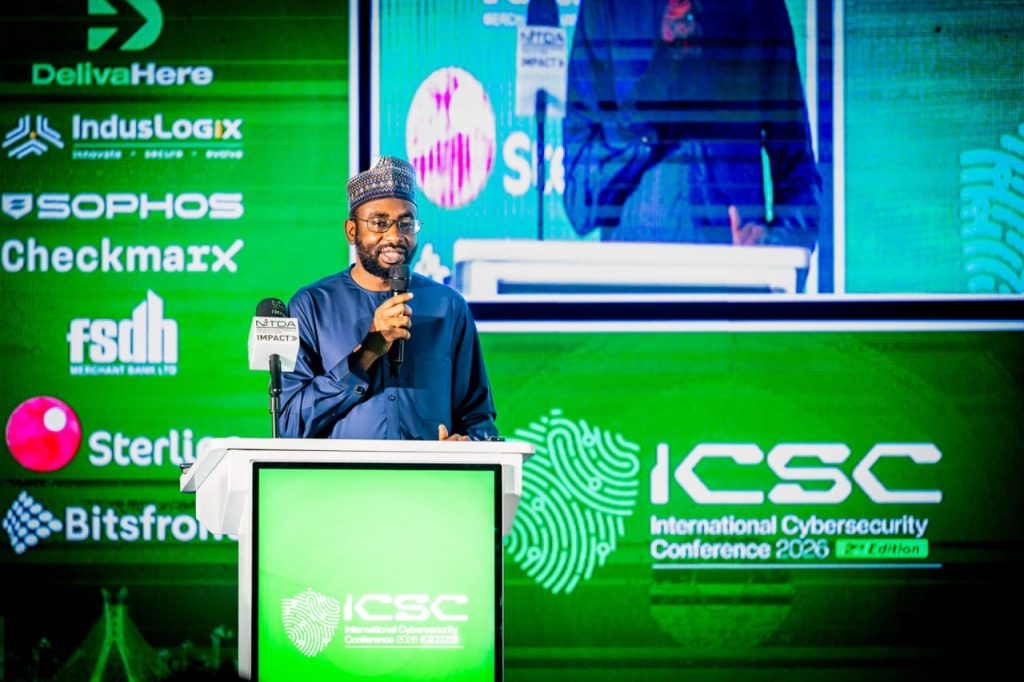
He said cybersecurity must now go beyond protecting computers and digital infrastructure to include protecting the human mind. According to him, attackers increasingly exploit human weaknesses because manipulating people is often easier than breaching sophisticated systems.
The conference, he added, will explore how individuals and institutions can build defences against both technical intrusions and human manipulation.
In his remarks, the Chairman of the Senate Committee on ICT and Cybersecurity, Senator Shuaib Afolabi Salisu, described the conference as a platform for technology diplomacy. He said the presence of foreign lawmakers showed growing international interest in Nigeria’s tech ecosystem and reinforced Nigeria’s appeal as a destination for digital business and collaboration.
Corroborating him, the Chairman of the House Committee on ICT and Cybersecurity, Hon. Adedeji Stanley Olajide, described cybersecurity as a moving target that requires continuous learning.
He warned that defence strategies that work today may be obsolete tomorrow, given how quickly AI is enhancing the capabilities of cybercriminals. He called for closer collaboration among practitioners, policymakers, diplomats, judges and heads of government agencies, stressing that cyber threats transcend borders.
“Countries across the Americas, Europe, Asia, Africa and Latin America must see cybersecurity as a shared challenge that demands coordinated action,” Olajide said.
On his part, the Chair of the Council of Europe’s Cybercrime Convention Committee (T-CY), Pedro Verdelho, said there is an urgent need to close the gap between rapid adoption of digital technologies and public understanding of their risks.
He noted that while AI tools have become part of everyday life — from travel planning to online shopping — awareness of the associated dangers remains low. He called for greater cybersecurity awareness among governments, private sector operators and citizens.
Verdelho also underscored the importance of the Budapest Convention on Cybercrime, the international treaty that promotes cooperation against cybercrime and facilitates access to electronic evidence, and welcomed growing participation from countries in the region.
In her goodwill message, the Swedish Ambassador to Nigeria, Anna Westerholm, said cybersecurity is critical to building public trust in digital transformation. She warned that while increased connectivity drives innovation, economic growth and inclusion, it also expands exposure to cyber risks.
She reaffirmed Sweden’s support for Nigeria’s digital transformation journey.


